

Careers in Computer Science & AI
A degree in Computer Science (CS) or Artificial Intelligence (AI) opens the door to a wide variety of exciting and rewarding career opportunities across nearly every industry. From developing software and designing intelligent systems to analyzing data, securing networks, and advancing cutting-edge technologies, graduates can pursue careers that solve real-world problems and shape the future.
This page is designed to help you explore the many career paths available with a CS or AI degree. Use these resources as a starting point to learn about common job titles, career fields, salary information, and the skills employers are seeking. As you explore your options, remember that job titles and qualifications can vary by employer. Be sure to review individual job descriptions to better understand the education, technical skills, and experience required for the roles that interest you.
Whether you're just beginning to explore your options or preparing to launch your career, we're here to help you navigate your next steps with confidence.
This list is intended to serve as a starting point for exploring the many career opportunities available to students pursuing degrees in Computer Science and Artificial Intelligence. The job titles included are examples of common career paths and are not an exhaustive list of what you can do with your degree.
Degree requirements can vary significantly by employer, industry, and position. Students are encouraged to carefully review job descriptions and qualifications for roles that interest them, as some employers may require a bachelor's degree in Computer Science, Artificial Intelligence, Software Engineering, or a related field, while others may specifically prefer or require a BA or BS degree.
In many cases, employers place greater emphasis on technical skills, projects, internships, work experience, and demonstrated competencies than on whether a student earned a BA or BS. However, there are some important considerations:
- Students interested in pursuing graduate school (Master's or PhD programs) may find that a BS degree provides stronger preparation due to additional coursework in mathematics, science, and technical electives.
- Certain government, defense, aerospace, and contracting positions may specifically require or prefer a BS degree.
- Specialized careers in artificial intelligence, machine learning, data science, robotics, and research often benefit from additional mathematics, statistics, or graduate-level education.
- Many software engineering, web development, cybersecurity, product management, consulting, and technology roles are accessible to students with either a BA or BS degree.
Use this guide as a starting point for career exploration and research. Students are encouraged to investigate specific career paths, review job postings, connect with professionals in their fields of interest, and meet with a Career Development Coordinator to discuss career goals and degree pathways.
Job Title | Description |
| Software Engineer | Designs, develops, tests, and maintains software applications and systems. |
| AI Engineer | Builds and deploys artificial intelligence and machine learning solutions. |
| Machine Learning Engineer | Develops algorithms and models that enable systems to learn from data. |
| Data Scientist | Analyzes large datasets to identify trends, generate insights, and support decision-making. |
| Data Engineer | Designs and maintains data pipelines, databases, and infrastructure for data processing. |
| Cybersecurity Analyst | Protects systems and networks from cyber threats, attacks, and vulnerabilities. |
| Cloud Engineer | Develops and manages cloud-based infrastructure and services. |
| DevOps Engineer | Automates software deployment, testing, and infrastructure management processes. |
| Full-Stack Developer | Builds both the front-end and back-end components of web applications. |
| Front-End Developer | Creates user-facing interfaces and experiences for websites and applications. |
| Back-End Developer | Develops server-side systems, APIs, and databases that power applications. |
| Game Developer | Designs and develops video games, game engines, and interactive experiences. |
| AI Researcher | Conducts research to advance artificial intelligence technologies and applications. |
| Robotics Engineer | Designs intelligent robotic systems that interact with the physical world. |
| Computer Vision Engineer | Develops systems that analyze and interpret images and video. |
| Natural Language Processing (NLP) Engineer | Creates AI systems that understand and generate human language. |
| Product Manager | Leads the development of technology products by coordinating technical and business teams. |
| Solutions Architect | Designs technology solutions to meet organizational and customer needs. |
| Systems Engineer | Builds and manages complex computer systems and technical infrastructure. |
| Site Reliability Engineer (SRE) | Ensures applications and systems are reliable, scalable, and efficient. |
| Quantitative Analyst | Uses mathematics, programming, and data analysis to support financial decision-making. |
| Business Intelligence Analyst | Uses data and analytics tools to support business strategy and performance. |
| Technical Consultant | Advises organizations on technology solutions and implementation strategies. |
| UX Engineer | Combines software development and user experience design to improve products. |
| Technical Program Manager | Oversees technical projects, timelines, and cross-functional teams. |
| Generative AI Engineer | Develops applications using large language models and generative AI technologies. |
| AI Product Manager | Guides the strategy, development, and deployment of AI-powered products. |
| AI Ethics Specialist | Evaluates responsible AI practices, fairness, privacy, and governance. |
| Prompt Engineer | Designs and optimizes prompts to improve AI system performance. |
| AI Solutions Consultant | Helps organizations implement and integrate AI technologies. |
| AI Operations (MLOps) Engineer | Manages the deployment, monitoring, and maintenance of machine learning systems. |
Computer Science (CS) and Artificial Intelligence (AI) are closely related fields, and many careers overlap. However, each degree has different areas of emphasis that may align better with your interests and career goals.
| Computer Science (CS) | Artificial Intelligence (AI) | |
|---|---|---|
| Primary Focus | Designing, building, and maintaining software and computer systems | Developing intelligent systems that can learn, reason, and make decisions |
| Core Skills | Programming, software engineering, algorithms, databases, operating systems, networking | Machine learning, deep learning, data science, neural networks, natural language processing, computer vision |
| Programming Languages | Java, C++, Python, JavaScript, C#, Go | Python, R, SQL, Java, C++ |
| Math Emphasis | Discrete mathematics, algorithms, logic | Statistics, probability, linear algebra, calculus, optimization |
| Typical Projects | Mobile apps, websites, operating systems, cloud services, embedded systems | Chatbots, recommendation systems, autonomous systems, predictive models, and generative AI applications |
Students in both majors may pursue careers such as:
- Software Engineer
- Backend Developer
- Full Stack Developer
- Cloud Engineer
- DevOps Engineer
- Systems Engineer
- Research Engineer
- Solutions Engineer
- Site Reliability Engineer (SRE)
Many employers hire both CS and AI graduates for software engineering roles, especially if applicants demonstrate strong programming skills and relevant project experience.
For many software engineering and technology positions, employers value your technical skills, projects, internships, and experience more than whether you earned a BA or BS in Computer Science. Students from both degree programs successfully pursue careers in software development, web development, cloud computing, cybersecurity, artificial intelligence, and many other technology fields.
However, there are situations where a BS may be advantageous. Some employers, particularly those in government, defense, aerospace, or highly technical engineering roles, may prefer or require a Bachelor of Science. A BS may also better prepare students who plan to pursue graduate school in technical or research-focused fields.
A BA offers greater flexibility, allowing students to pursue a second major, minor, language studies, business, or other interdisciplinary interests while still building strong technical skills.
When deciding between the BA and BS, ask yourself:
- What type of career do I want to pursue?
- Am I interested in graduate school or research?
- Do the employers I'm interested in have a preference for a BA or BS?
- Would I benefit from the flexibility of the BA to pursue another area of interest?
If you are well into completing your BA degree requirements, we strongly encourage you to meet with your academic advisor before switching to the BS. Changing degree programs may require additional coursework and could delay your anticipated graduation date. Your academic advisor can help you understand how a change would affect your degree plan and expected graduation timeline.
Make an appointment with your academic advisors via Trellis.
Neither degree is inherently "better." The best choice is the one that aligns with your career goals, academic interests, and long-term plans. If you're unsure which option is right for you, schedule an appointment with your academic advisor and Career Development Coordinator to discuss your goals and develop a plan that best fits your future.
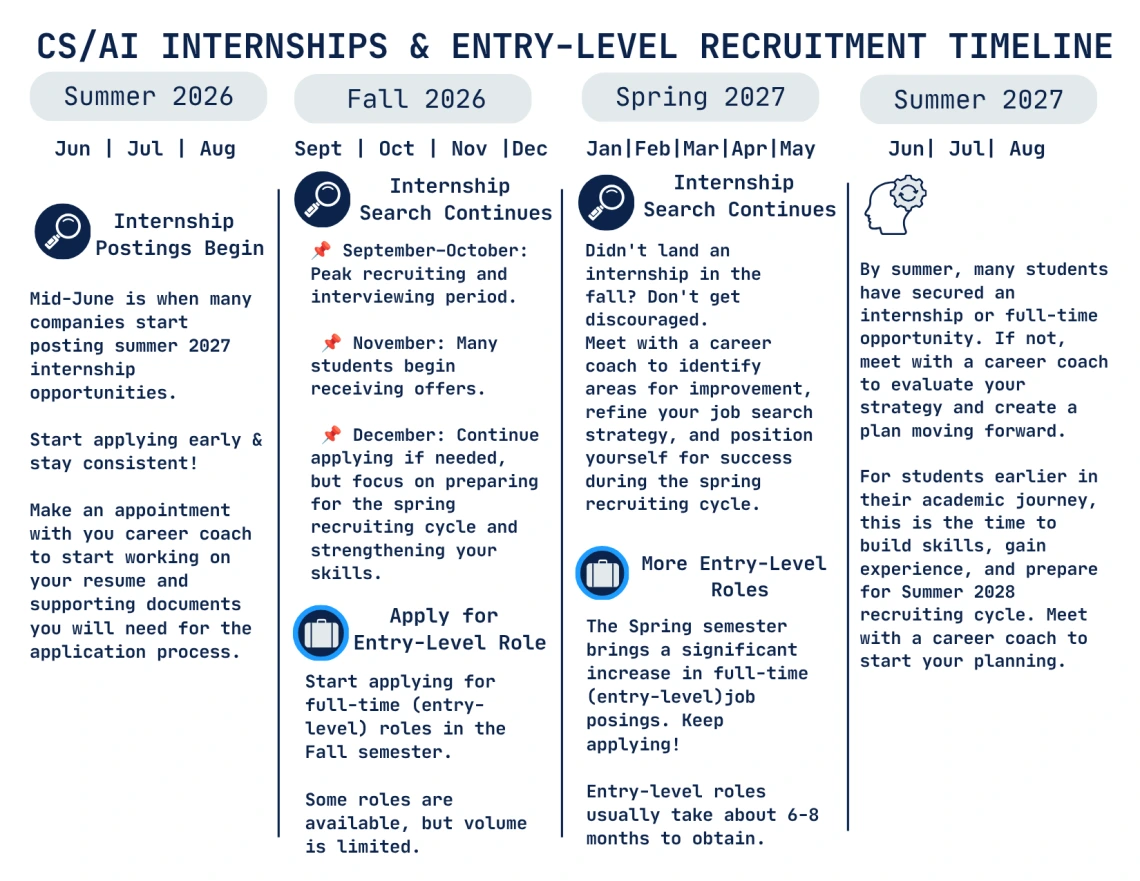
The recruiting timeline for Computer Science and Artificial Intelligence positions often begins much earlier than students expect. Many employers recruit nearly a year in advance, so it's important to start preparing and applying early.
Internship Recruiting Timeline
- Surging Requirements: The demand for AI skills in entry-level tech roles has nearly tripled over the last year.
- Emerging Career Tracks: Beyond traditional data science, companies are actively recruiting for specialized entry-level positions like Prompt Engineers, AI Governance & Compliance Specialists, and Machine Learning Operations (MLOps) Assistants.
- Evolving Responsibilities: Employers report that AI is not replacing entry-level workers. Instead, it is automating routine programming and data cleaning tasks. This means you will be expected to handle higher-level system architecture and analytical problem-solving much earlier in your career.
Key Takeaway for CS/AI Wildcats:
AI is changing how software is built, not eliminating the need for computer scientists/AI scientists. Students who combine strong Computer Science fundamentals with AI literacy, communication skills, and hands-on experience through internships and projects will be well prepared for the future workforce.
NACE Articles & Other Resources:
Demand for AI Skills in Entry-Level Jobs Nearly Triples Since Fall 2025
The New Jobs AI Is Creating and How It Will Impact Recruiting
AI and Entry-level Jobs: Higher-level Skills Replace Grunt Work
Want to learn how much these careers pay? Explore salary ranges, job outlook, and industry trends using the resources below:
- Labor Market Trends: http://career.cales.arizona.edu/labor-market-trends/
- Levels.fyi: https://www.levels.fyi
- O*NET OnLine: https://www.onetonline.org
- U.S. Bureau of Labor Statistics (BLS): https://www.bls.gov/ooh
- Glassdoor: https://www.glassdoor.com/Salaries/index.htm
These resources can help you research salary expectations, required skills, and career outlooks for a variety of Computer Science and Artificial Intelligence careers.
Salary negotiation is a normal part of the hiring process, especially in the technology industry. Employers often expect candidates to ask thoughtful questions about compensation. By researching the market, understanding your value, and approaching the conversation professionally, you can advocate for yourself while maintaining a positive relationship with your future employer.
Tips on how to manage a salary negotiation.
1. Always Research Market Salaries
Before discussing compensation, understand what professionals in similar roles are earning.
- Research:
- Job title
- Location
- Company size
- Industry
- Internship vs. full-time
- Use multiple salary resources to establish a realistic range.
2. Evaluate the Entire Compensation Packet
A higher salary doesn't always mean a better offer.
Consider the following:
- Base salary
- Signing bonus
- Annual bonus
- Restricted Stock Units (RSUs) or equity
- Retirement contributions
- Health insurance
- Paid time off
- Relocation assistance
- Professional development benefits
- Remote or hybrid work options
- Visa sponsorship (if applicable)
3. Wait Until You Have a Written Offer
Avoid negotiating before you receive an official offer.
Once you have a written offer:
- Thank the employer.
- Review the details carefully.
- Ask about the timeline for responding if needed.
4. Be Professional and Appreciative
Negotiation should be a conversation, not a demand.
Express excitement about the opportunity while respectfully discussing compensation.
Example: "Thank you for the offer. I'm excited about the opportunity to join your team. Based on my research and the skills I'll bring to the role, I was hoping there might be flexibility in the compensation."
5. Know Your Value
Consider what makes you a strong candidate.
Examples:
- Previous internships
- Research experience
- Open-source contributions
- Personal or class projects
- Leadership experience
- Technical certifications
- Specialized AI or software engineering skills
6. Have a Salary Range
Instead of giving one specific number, provide a reasonable range based on your research if necessary.
7. Everything May Be Negotiable
If the employer cannot increase salary, ask whether they have flexibility with:
- Signing bonus
- Relocation assistance
- Start date
- Additional vacation time
- Professional development funding
- Remote work flexibility
- Conference or certification support
8. Don't Rush Your Decision
Ask for time to evaluate the offer. Many employers expect candidates to take a few days to review the details before accepting.
9. Compare Multiple Offers Carefully
Consider more than salary.
Ask yourself:
- Will I enjoy the work?
- What mentorship opportunities are available?
- What are the growth opportunities?
- Does the company culture fit my goals?
- What technologies will I learn?
- Is the location a good fit?
Internships:
Students should also be careful about accepting multiple internships that overlap or trying to “stack” internships during the same term. Many employers expect your full professional commitment during the internship period, even if the role is remote. If you are considering more than one internship, review each employer’s policies and be transparent before accepting. Failing to disclose overlapping commitments could damage your professional reputation, create scheduling conflicts, or violate company expectations.
When in doubt, speak with a career advisor before accepting or negotiating multiple offers.
10. Practice Before Negotiating
Negotiating can feel uncomfortable if you've never done it before. Preparation builds confidence.
Practice with:
- A career advisor
- A mentor
- A trusted friend
- A mock negotiation session
11. Be Prepared to Accept "No"
Some companies have fixed compensation for entry-level hires or interns.
If the answer is no:
- Remain professional.
- Thank them for considering your request.
- Decide whether the overall opportunity still aligns with your career goals.
Common Mistakes to Avoid
- Negotiating before receiving an offer
- Accepting the offer immediately without reviewing it
- Focusing only on salary instead of total compensation
- Comparing yourself to friends instead of market data
- Using ultimatums or aggressive language
- Negotiating without researching salary ranges
- Forgetting to get any agreed-upon changes in writing